
Measuring Stamina Progress: Expert Strategies for Athletes and Beginners

Introduction: Why Tracking Progress Matters
Stamina isn’t just a fitness buzzword, it’s our body’s ability to sustain physical or mental effort over time. Whether we are training for a marathon or simply aiming to run longer without gasping for air, stamina is key.
But here’s the kicker: Only 20% to 30% of gym-goers stick to their fitness goals long-term. Why? One of the main reasons is not measuring progress, and what isn’t tracked rarely improves.
This guide is a potential roadmap. We’re combining science backed expert opinion with practical tools to help both athletes and beginners track, optimize, and evolve their stamina, naturally.
The Science of Stamina Gains

Adaptation and Recovery
Stamina builds through a cycle: apply stress → allow recovery → adapt stronger.
Known as the SAID Principle (Specific Adaptation to Imposed Demand), this is how our body improves mitochondrial function, cardiovascular efficiency, and muscular endurance.
Why Progress Plateaus (and How to Break through)
Even the best plans hit a wall. Common culprits being:
- Overtraining: Which means no time to recover = no growth.
- Under-recovery: Sleep, nutrition, and rest days matter as much as workouts.
The solution? Structured periodization.
Periodization is the strategic division of your training into specific phases, such as build, peak, and deload, each designed to stimulate adaptation while preventing burnout. This method helps reboot progress by introducing planned variations, while giving one’s body the time and stimulus it needs to grow stronger.
Metrics That Matter: Tracking Stamina Objectively
Understanding how to measure stamina progress is crucial for long-term success. Different fitness levels require different approaches to tracking, but the key is consistency and choosing metrics that align with one’s current abilities.
For Athletes: Advanced Performance Metrics
VO₂ Max: Gold standard of aerobic capacity.
VO₂ Max represents the maximum amount of oxygen our body can utilize during intense exercise, measured in ml/kg/min. It’s like the body’s engine size – the bigger the engine, the more fuel it can burn for energy. This can be measured through professional lab testing, fitness watches or field tests like the Cooper 12-minute run.
Lactate Threshold: Predicts endurance under high effort
The lactate threshold is the exercise intensity where lactate accumulates faster than the body can clear it – essentially our sustainable “red line.” It’s often a better predictor of endurance performance than VO₂ Max for events lasting 30 minutes or longer. One can identify it as the heart rate zone where one can speak in short phrases but feel challenged.
Time-to-Exhaustion & HR Recovery: Faster HRR = better fitness.
Time-to-exhaustion measures how long one can maintain a specific challenging pace before fatigue forces us to stop. Heart Rate Recovery (HRR) tracks how quickly the heart rate drops after exercise – good recovery shows a 12+ beat drop in the first minute.
Black Thunder Active+’s has natural ingredients, such as Ashwagandha that helps improve heart rate recovery.
For Beginners: Accessible and Practical Measures
Talk Test & RPE (Rate of Perceived Exertion): Can You Speak a Full Sentence While Exercising?
The talk test is simple: if one can hold a conversation while exercising, you’re in Zone 2 – the perfect intensity for building stamina. Use the RPE scale (1-10) to quantify effort, aiming to start at RPE 4-5 and finish at RPE 6-7. This approach builds the aerobic base without overwhelming one’s system.
Distance Tracking: Log walking or jogging distance without fatigue.
Track the distance one can cover comfortably without excessive fatigue or needing extended recovery. Focus on gradually increasing the comfortable distance each week rather than pushing for speed. One should feel ready for another session within 24-48 hours of your previous workout.
Consistency Logs: Use journals or apps to track how often you work out.
Consistency is the most powerful predictor of stamina improvement, so track the exercise frequency along with how one felt. Log exercise type, duration, perceived effort, mood, and sleep quality using apps like Strava or a simple notebook. Review weekly to identify patterns between the lifestyle factors and performance.
Subjective Indicators: The Often-Overlooked Metrics
Mental Stamina: Are you zoning out mid-workout or staying present?
Mental stamina and physical stamina are deeply connected – mental fatigue can limit performance just as much as muscular fatigue. Track your ability to maintain focus, form, and breathing awareness throughout workouts. Notice whether you’re looking forward to exercise sessions or dreading them.
Mood & Sleep: Recovery reflects here:
One’s mood and sleep quality provide early indicators of whether the training load is appropriate. Track time to fall asleep, wake-ups during the night, morning energy levels, and general sense of well-being. Poor sleep or persistent irritability often signals the need for more recovery
Boost Tip: Shilajit in Black Thunder Active+ by Ubalance Naturals, enhances focus and motivation during endurance training.
Specialized Training Strategies to Build Stamina

For Endurance Athletes: Advanced Periodization
Zone 2 Training: Workouts at 60 – 70% max HR improve fat utilization.
Zone 2 training occurs at a conversational pace where the body primarily burns fat for fuel while building aerobic capacity. Train for 45-90 minutes, 2-4 times per week at an intensity that feels “comfortably hard” but sustainable. You should be able to maintain the same pace with decreasing heart rate over time, indicating improved efficiency.
Tempo + LSD Runs: Build both speed and endurance.
Tempo runs train one’s lactate threshold with 20-40 minutes at “comfortably hard” pace (RPE 7-8), sandwiched between warm-up and cool-down. Long Slow Distance runs build aerobic capacity and mental resilience with 60-180 minutes at conversational pace. Alternate emphasis between tempo and LSD work every 4-6 weeks to prevent plateaus.
Cross-Training: Alternate cycling, swimming, or hiking to avoid burnout.
Incorporate different activities like swimming, cycling, or hiking to build stamina while reducing overuse injury risk. Replace 1-2 weekly sessions of your primary sport with cross-training, or use it during recovery weeks. Focus on activities that complement rather than compete with your main training goals.
For Beginners
Low-Impact Routines: Walking, Elliptical, or Yoga Work Well
Start with walking progressions: 15-20 minutes daily for weeks 1-2, building to 30-40 minutes with hills by weeks 5-8. Elliptical training provides cardiovascular challenge without joint impact, while power yoga builds muscular endurance and breath awareness. These activities allow the musculoskeletal system to adapt gradually to increased activity.
10% Rule: Increase time or intensity by no more than 10% per week.
Apply the 10% rule to prevent overuse injuries while ensuring consistent progress – if you exercised 100 minutes this week, aim for 110 minutes next week. Increase total weekly exercise time, distance, or intensity, but not all three simultaneously. Take a recovery week (reduce by 25-30%) every 4th week.
Prioritize Recovery: Use rest days for stretching and mobility.
Recovery isn’t just rest – it’s an active process including gentle walking, dynamic stretching, light yoga, or easy swimming. Ensure 7-9 hours of quality sleep, proper hydration, and stress management techniques. Schedule recovery weeks regularly rather than waiting until you feel overtrained.
Natural Support for Stamina Progress

Nutritional Pillars
- Macronutrient Balance: Carbs fuel, fats sustain, proteins repair.
- Hydration: Essential for energy metabolism.
Supplement Support from Ubalance Naturals
Introducing Black Thunder Active+ by Ubalance Naturals, a scientifically formulated stamina enhancer designed to support endurance training and help you overcome plateaus.
Thoughtfully formulated with over 20 ancient and adaptogenic herbs that work synergistically to support energy, endurance, recovery, and overall well-being.
Let’s break down how:
Energy & Endurance Boosters
Shilajit, Ginseng, Ashwagandha, and Safed Musli help power up the energy levels and improve oxygen use during workouts. These adaptogens are known to enhance mitochondrial function, boost oxygen utilization, and improve cellular energy. Shilajit and Ginseng, in particular, are well-documented for their fatigue-fighting and revitalizing properties, helping you power through endurance workouts with sustained energy.
Focus, Mood & Mental Resilience
Ingredients like Kesar, Jaiphal, and Ashwagandha help reduce stress and sharpen focus.
They play a key role in sharpening focus, reducing stress, and improving mental clarity, essential for pushing through mentally taxing training sessions. Ashwagandha and Kesar are especially prized in Ayurveda for their adaptogenic and mood-stabilizing effects.
Muscle Recovery & Strength Support
Kaunch Beej, Gokhru, and Akarkara support muscle repair and natural testosterone balance. Gokhru and Akarkara are traditionally used to support muscle resilience and joint flexibility. Ideal for bouncing back stronger after intense training days.
Mineral-Rich Vitality Enhancers
Loh Bhasam, Moti Bhasam, and Vang Bhasam boost mineral reserves and inner stamina.
These classical Ayurvedic mineral preparations help improve nutrient absorption, boost hemoglobin levels, and support cellular repair, ideal for those undergoing physically demanding routines.
Gut and Detox Support
Aloe Vera, Triphala, and Ginger keep digestion smooth and inflammation low.
These ingredients support digestion, nutrient assimilation, and detoxification, ensuring our body processes nutrients efficiently and remains inflammation-free during training cycles.
A healthy gut means better nutrient absorption and overall performance.
With this powerful formulation, Black Thunder Active+ doesn’t just support stamina, it optimizes performance, recovery, and hormonal balance, naturally.
Pro Tip:
Begin supplementing with Black Thunder Active+ during week 2 of your stamina plan to elevate energy metabolism and reduce perceived exertion during endurance training.
The Mind-Body Connection
Mental Endurance Training: Mindfulness, breathwork, visualization: these aren’t just for monks.
Overcoming Plateaus: Address self-doubt, low motivation, and burnout.
Digital Tools: Apps like Headspace, Calm, or journaling can elevate stamina through mental focus.
Putting It into Practice: A 4-Week Stamina Tracking Plan
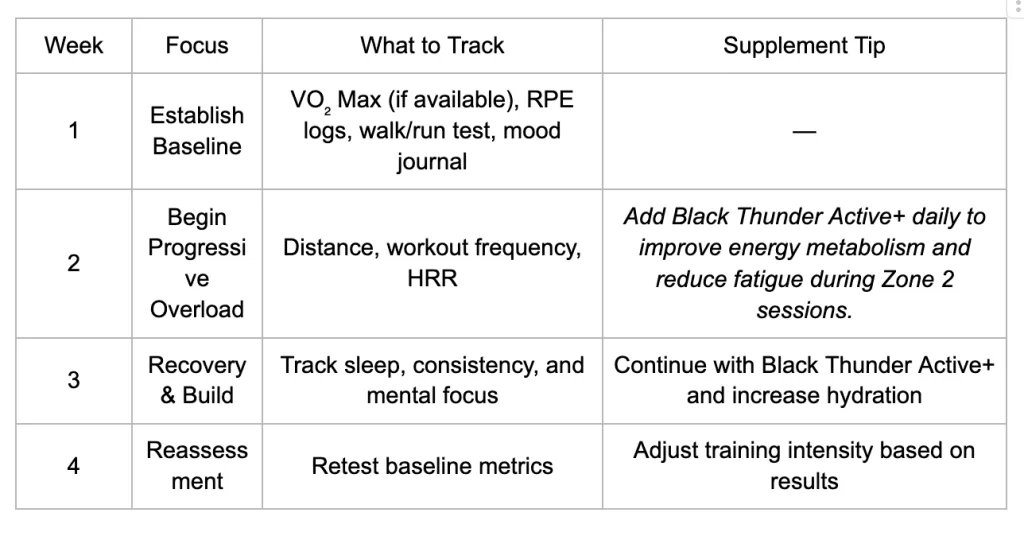
Stamina Progress Tracker
Create a Stamina progress tracker for yourself to log your:
- VO₂ Max
- RPE scale
- Mood + Sleep quality
- Daily supplement intake
Bonus: Plateau-Breaking Checklist
5 Signs You Need to Adjust Metrics or simply add Black Thunder Active+ to your routine
- HR recovery has stalled despite consistent training.
- You feel mentally exhausted even after rest days.
- Your distance or speed hasn’t improved in 3+ weeks.
- Sleep quality is poor and workouts feel harder.
- You’ve stopped logging workouts due to low motivation.
✅ Reassess your plan, adjust your metrics, and introduce Black Thunder Active+ from Ubalance Naturals – a 100% natural, plant-based supplement with no added sugar, chemicals, or additives. It contains 20 supportive adaptogens like Ashwagandha, Shilajit, Safed Musli, Shatavari, and others.It offers a pure, plant-based stamina boost without any highs or crashes. Instead of working on the body, it works with the body and mind to create balance and optimize performance.
Stamina is a moving target. It changes with stress, nutrition, age, and mental state. But what doesn’t change is this: What you measure, you can improve.
Let Ubalance Naturals support your journey: every step, breath, and heartbeat of the way.
Explore our custom curated supplements and take care of yourself naturally!